
Make Your Second Shibuya Street Kart Ride Coincide with a Local Event: An Easy Plan for a Group of Mixed Ages
Make Your Second Shibuya Street Kart Ride Coincide with a Local Event: An Easy Plan for a Group of Mixed Ages
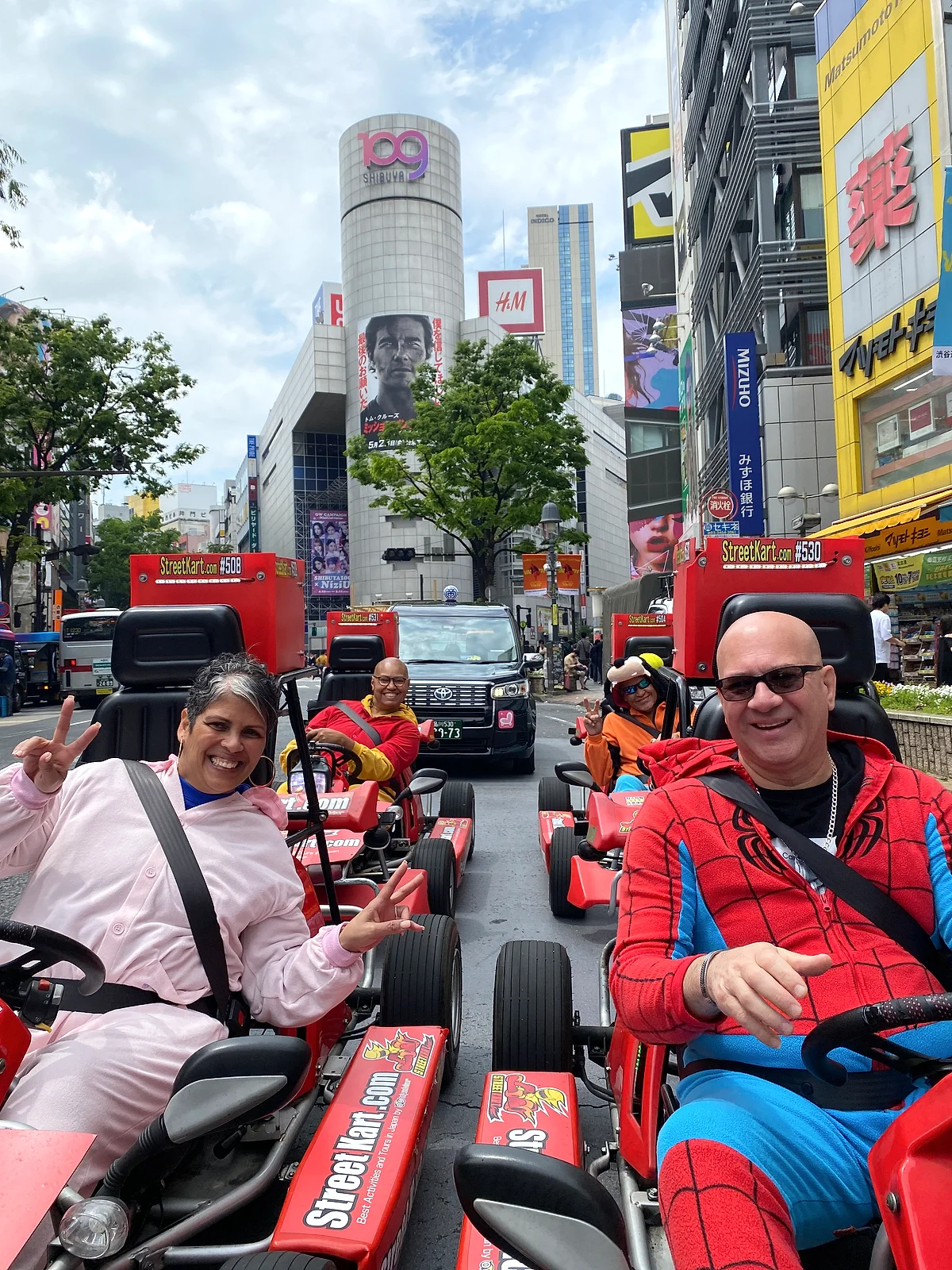
The light at Scramble Crossing turns green. Crowds surge in from every direction, and a line of karts rolls slowly along the edge. If you've ridden a street kart in Shibuya even once, you probably still remember how hard your heart was pounding.
So what about the second time? Retracing the same route with the same feelings would be a bit of a waste. Instead, pick a day when an event is drawing crowds to Yoyogi Park or Omotesando. Take a loop around the city by kart, then walk over to the event. That's the kind of day we suggest for your second time.
This article sets out a way of thinking that lets a group with very different ages and stamina levels enjoy a second trip to Shibuya without overdoing it.
Shibuya's "Other Rhythm," Noticed Only by Those Who've Driven It Once
Honestly, the first time around, just keeping up with the kart in front of you takes everything you've got. The guide's signals, the traffic lights, the people filling the crossing. There's so much to take in that many people find themselves back at the shop before they know it.
The second time is a little different. Because you already know how it goes, you have some room to breathe. Passing through the zelkova trees of Omotesando, you notice the color of the leaves and the light spilling through the gaps in the branches. Near the entrance to Takeshita Street, you can tell where the voices are coming from.
The same thing happens with music. The first time, you hear the song as a whole. Only on the second listen do the bassline and the fine ticks of the hi-hat stick with you. Shibuya is the same: it takes a second visit before you can finally hear the details.
Shibuya offers Tour HS, which heads from Shibuya to Harajuku and Omotesando, and Tour H2S, which runs from Scramble Crossing through Dogenzaka and Omotesando to Harajuku. If you did one of them the first time, choosing the other for your second ride is a good option. Even on the same Omotesando, the trees look different when you come in from another direction. And climbing the slope of Dogenzaka in a kart feels nothing like walking it.
Looking back over your photos from the first ride is also good preparation. Compare the places you captured with the ones you missed. Near Scramble Crossing stands SHIBUYA109, and along Omotesando you'll find Omotesando Hills and Tokyu Plaza Omotesando Harajuku. Pick just one building you passed without noticing last time. There's no need to crane your neck looking for it while you drive. It's enough to recognize it when it comes into view: "That's the one." Having just one thing to look for changes how you take in the same road.
First, one point to keep in mind. Street Kart is a guided tour that follows a fixed route set by each shop. Treat the event venue as something separate from the tour route, and visit it on foot before or after your ride. Keeping these two apart makes planning the day much easier.
What Changes When You Drive Shibuya on an Event Day?
The sights you'll see on a Shibuya tour include Scramble Crossing, the high-rises around Shibuya Station, Takeshita Street in Harajuku, and the zelkova-lined avenue of Omotesando. You've seen them all before, yet on a day when the city is hosting an event, they look different.
Yoyogi Park sometimes hosts festivals and flea markets. On those days, the footsteps of people heading toward the park carry a slightly giddy energy that spreads through the whole city. You can feel it from your kart, in the clothes people on the sidewalk are wearing and the things they're carrying.
The zelkova trees of Omotesando are also well known as a photo spot for the winter illuminations. If you drive during the season when the trees are draped in light, the street may look completely different from the green avenue you saw the first time. However, the timing of illuminations and events, and whether they're held at all, varies from year to year.
On event days, there are more people on the sidewalks and at the crossings. The busier it is, the more attention you'll want to pay to the gap between you and the kart ahead and to the guide's signals. Because you're more relaxed than the first time, it's tempting to look around. But save the scenery for when you're stopped and for your walk after the tour.
We recommend kart first, event second. At an event, your hands tend to fill up with food and purchases before you know it. You can only bring a fairly small bag on the kart, and the lockers at the shop are meant for small items. Drive while you're traveling light, and pick up extra baggage afterward. Decide this in advance, and you won't be stuck wondering where to put your shopping bags before check-in. Another bonus of this order is that you can walk into the event still riding the high from your drive.
When pairing your ride with an outdoor event, keep an eye on the weather too. In light to moderate rain, the tour runs as scheduled, and raincoats are provided free of charge. In heavy rain or typhoons, the tour is canceled, and you can choose a shortened tour (with the difference refunded), a date change, or a full refund. What happens to the event in the rain is up to the organizer. Checking both announcements the day before will save you from scrambling on the day.
How a Group with Different Ages and Energy Levels Can Take It Easy
This is the part I most want to get across. Among your travel companions, some love walking, while others find standing for long periods hard. Some want to take the wheel; others would rather watch. If you try to make everyone do the same thing at the same pace, someone usually ends up quietly worn out.
Make Time for Both Drivers and Those Waiting
The karts are single-seaters, and passengers can't ride along. There are other requirements as well: you must be 18 or older and bring the original of a valid driver's license that allows you to drive a car. The documents you need also depend on the type of license. Check on the official website before your trip to confirm who can drive and the details of the requirements.
Drivers must bring the original of their driver's license. Digital licenses are not accepted. If you don't have the required documents on the day, you won't be able to take part, and there's no refund. People often swap things in and out of their wallets while traveling, so reminding one another the night before is a good idea.
Let the drivers know about clothing, too. Closed-toe shoes, preferably sneakers, are recommended. Sandals, heels, skirts, and dresses are best avoided. Since you'll be walking to the event afterward, sneakers will carry you through the whole day. It's a good idea to pack everything into a fairly small bag.
If anyone in your group is pregnant, driving is not recommended. The karts have no suspension, so every bump in the road comes straight through. If you have concerns, consult a doctor. On days when you have companions like this, it's all the more worth planning an enjoyable time for those who wait.
With all that in mind, I think splitting the group into those who drive and those who don't is the least awkward way to organize things.
Those who aren't driving can shop or eat at Shibuya Hikarie, about a 10-minute walk from the Shibuya shop, while they wait. Blue Bottle Coffee Shibuya, also about 10 minutes away on foot, is a nice place to take a break. For anyone who wants to see the city from above, there's the Shibuya Sky observation deck at Shibuya Scramble Square. You can look straight down on the crossing your friends just drove through in their karts. Comparing notes afterward makes for lively conversation.
If you'd like to stroll some busy streets, take a look at Shibuya Center Gai or Spain-zaka, about a 12-minute walk from the shop.
The trick to choosing a meeting spot is to pick somewhere easy to find. The Shibuya shop and Shibuya Annex in Maruyamacho are practically in the same place. The Hachiko statue, about a 10-minute walk from the shop, has long been a famous meeting spot. On event days, though, it gets very crowded. Decide in advance which side of the statue you'll wait on. Drop a pin on a phone map and share it, and things will usually work out even if you're not confident in the language.
Giving those who wait a small task also eases the feeling of being left behind. For example, ask them to go and check where the event entrance is. Have them figure out the route to the station you'll use on the way home. Ask them to come up with two or three options for where to eat once you meet up. When the drivers come back and the next destination is already decided, the day flows without a break. And those who waited come away with more than just time killed.
Walk to the Event, and Agree on Distances Ahead of Time
If you're heading to an event after the tour, make sure everyone knows the walking distances in advance. From the Shibuya shop, Yoyogi Park and Meiji Jingu are about a 20-minute walk. Omotesando is about 15 minutes on foot, as is Takeshita Street in Harajuku. That may be a pleasant stroll for energetic people, but it could be a heavy distance for someone with sore feet or legs.
In that case, splitting into two groups is an option. Those who like walking can pass through the sacred forest of Meiji Jingu to Yoyogi Park. Right in the middle of the city, there's a moment when the air suddenly turns cool, and that alone makes the walk worthwhile. Those who tire easily can take the train or rest at a café along the way, then meet up at the venue. The nearest stations are Shinsen Station, about 5 minutes on foot from the shop, and Shibuya Station, about 10 minutes away.
It also helps to scout out a few places to rest along the way. In Omotesando, there's Luke's Lobster Omotesando; in Harajuku, the crepes on Takeshita Street. Just stopping with something in your hand makes a big difference to tired legs. Deciding on rest spots in advance also makes it easier for tired people to say, "I'd like a little break." Older companions in particular tend to put up with it rather than speak up.
Before setting off, buy drinks and stop by the restroom to make things easier later. There are convenience stores within a 5-minute walk of each shop, and the shops themselves have restrooms. Take care of what you can before you end up waiting in lines around the venue.
On event days, the area around the venue is crowded and can drain more energy than you'd expect. Aim for "everyone still smiling at the end" rather than "seeing everything," and you'll be about right.
Booking and Day-of Logistics to Keep in Mind
Street Kart bookings tend to fill up on weekends. If you want to drive on the weekend of an event, we recommend booking as soon as your dates are set.
Same-day bookings are accepted if there are openings. In that case, you need to arrive at the shop 30 minutes in advance. Large groups may not find enough open slots together. Please check the official website (kart.st) for group size requirements.
If the event schedule is still up in the air, it's worth checking the cancellation terms first. You can cancel free of charge up to 7 days in advance. Payment is made in full in advance via PayPal, and multiple people can pay separately through the same payment link. That means no one has to cover everyone and settle up later. Terms may change, so check the latest information on the official website before booking.
We recommend using public transportation on the day. The shops don't have parking. Checking the walking route from Shinsen or Shibuya Station on a map the night before will give you peace of mind.
Another important point is to leave yourself some slack before and after the tour. On event days, simply getting out through the ticket gates at Shibuya Station can take longer than you'd think. There's also check-in and a safety briefing, so follow the meeting time given when you book and plan to reach the shop with time to spare. That gives you a moment to settle in before you set off.
Note that instructions on the day of the tour are generally given in English. Guidance in Japanese or other languages depends on the staff that day and isn't guaranteed. The official website supports 22 languages, but that applies only to the site, not to the guidance during the tour. If you're concerned, contact them through the official website beforehand.
Back to Shibuya, Moving to the Pulse of the City
If your first street kart ride was your introduction to Shibuya, the second is a chance to discover another side of it. Drive on a day when an event has the city buzzing, and even the familiar crossing and zelkova trees will look a little different.
Try planning a day where drivers and onlookers alike can go at their own pace. Who takes the wheel, and who waits in a café? Where do you meet up? Once that's settled, all that's left is to let Shibuya set the rhythm.
On the way home, share your separate days with one another. The drivers can talk about the crossing they saw over the steering wheel. Those who waited can talk about the city they saw from a café window or the observation deck. You were all in the same Shibuya, yet some of your stories won't quite match up. That mismatch is exactly what makes a day where everyone didn't do the same thing so rewarding.
For the latest tour information, such as course details and how to book, see the official website. For event schedules, check with each organizer.
That night, a small squabble over which side of Hachiko you were supposed to meet on is probably just about right.
This article was originally written in Japanese and translated using AI. Some expressions may read unnaturally, and we appreciate your understanding. For the most accurate and up-to-date information, please refer to the official site at kart.st.
Street Kart is not affiliated with Nintendo or the Mario Kart series in any way. We do not provide costumes of Nintendo characters, and such costumes may not be worn during tours even if brought by participants.